The evidence is about teams, not tools
Calling a system “human in the loop” says very little about how people and AI actually share a task. The AI may act as a second reader, prioritise cases, draft an output for verification, or influence a treatment decision. Each arrangement changes what success means.
We therefore reviewed empirical human–AI collaboration studies across healthcare rather than asking whether AI was accurate in isolation. The review covers work published from January 2015 to October 2025 and maps where collaboration was tested, how it was evaluated, and which technical, human, and organisational factors shaped the result.
Where the evidence is concentrated
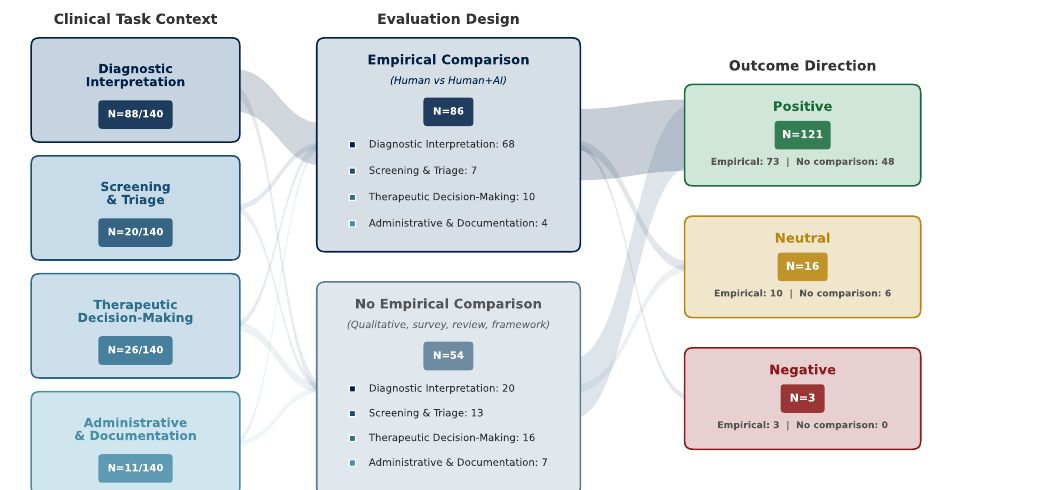
Diagnostic interpretation dominates the literature. Eighty-six studies made a direct human-only versus human-plus-AI comparison; the rest used qualitative, survey, implementation, or other non-comparative designs. Positive-direction findings were common, but that should not be read as a pooled estimate of effectiveness: tasks, designs, and outcomes were heterogeneous, and many studies were controlled reader experiments.
What makes collaboration work?
Benefits depended on alignment between the technology, the person using it, and the organisation around them. Four recurring determinants cut across the literature.
Complement the judgement
Bounded subtasks—prioritisation, highlighting, drafting, or pre-segmentation—were the clearest fit.
Communicate uncertainty
Explanations sometimes helped, but could also add cognitive load or invite unwarranted certainty.
Train for appropriate use
Onboarding and continuing support matter, especially when users must detect when the AI is wrong.
Fit the real workflow
Integration, leadership, escalation routes, and shared success criteria shape whether a tool is usable.
Trust is not the same as reliance
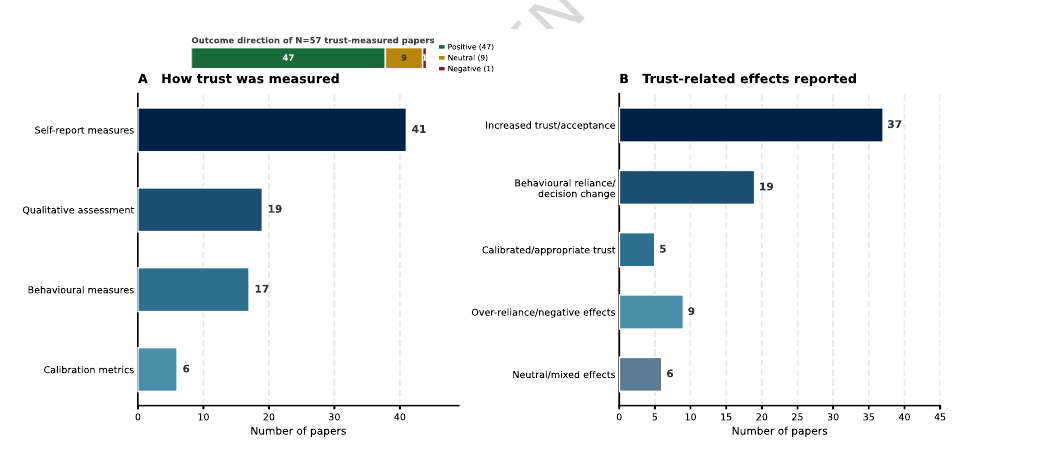
The goal should not be to maximise trust. It should be to support appropriately calibrated trust: reliance when the AI is likely to help, and scrutiny or override when it is not. A stronger evaluation triangulates subjective ratings, observed behaviour such as advice-taking and escalation, and calibration against objective correctness.
What better evidence would look like
Accuracy, time, workload, cognitive burden, and reliance at the point of use.
Adoption, escalation, override, equity, and how work is redistributed across a service.
Clinical outcomes, resource use, safety events, and whether benefits persist over time.
Traceability, contestability, accountability, and explicit control over how AI shapes decisions.
Only 11 of the 140 studies used implementation-focused designs. Accountability and safety were often discussed but rarely tested. The evidence base now needs to move beyond short-term task comparisons toward longitudinal, in-situ studies of the complete clinical system.
Conclusion
Human oversight is not a safety property by itself. Collaboration works when the task is well matched, the interface supports appropriate reliance, the workflow makes intervention possible, and governance gives people meaningful control. The unit of evaluation must therefore be the human–AI system in context—not the model alone.