The handover is part of the prediction
A chest X-ray can contain several related findings at once. A model may predict a broad category such as lung opacity, more specific children such as consolidation or oedema, and decide independently for each finding whether to answer or defer to a radiologist.
That last step sounds like ordinary multi-label learning to defer, but the labels form a taxonomy. If consolidation is present, then lung opacity—and, above it, abnormality—must also be present. A set of individually sensible actions can therefore describe an impossible or confusing handover when combined.
Three ways independent deferral can break
Suppose a parent and child can each be marked absent (), present (), or deferred (). Treating those two nodes independently creates three distinct failure modes.
Taxonomic contradiction
The model says a parent is absent while asserting that one of its children is present.
Delegation violation
The parent is handed to the reader, but a child prediction already implies the parent's value.
Deductive defect
The model defers a child even though its own parent assertion has already forced the answer.
These are not just quirks of imperfect training. We show that a Bayes-consistent node-wise model can still produce delegation violations and deductive defects because its independence structure never reasons about the handover as a whole.
Defining a coherent action
We formalise a selective-exclusion handoff contract. Let be the actions at each node. The parent action determines which child actions are allowed:
An absent parent forces an absent child; a present parent leaves all options open; and a deferred parent permits an absent or deferred child, but not a present child that would answer the delegated question indirectly. The coherent action set is therefore
This turns coherence into a precise contract rather than a vague wish that neighbouring predictions should agree.
Two ways to enforce the contract
Both methods begin with the same primitive outputs: for each node, a learning-to-defer head estimates scores for absent, present, and defer. They differ in where the hierarchy enters the system.
1. Exact coherent projection
Projection chooses the highest-scoring joint action from. A brute-force search would examine action vectors, which becomes impossible even for a modest taxonomy. Because the labels form a tree, dynamic programming can solve the same optimisation exactly in time— effectively linear in the number of findings.
This is attractive when an existing node-wise model needs a reliable safety layer: no retraining is required, and every final action vector is coherent.
2. Taxonomic Belief Propagation with Recursive Policy Optimisation
Projection repairs a policy after it has been learned. Taxonomic Belief Propagation (TBP) instead pushes probability mass down the tree according to the allowed transitions. Recursive Policy Optimisation (RPO) then trains through that recursion, so losses at descendants also teach ancestors which actions preserve useful downstream options.
The result is a hierarchy-aware policy rather than a collection of independent heads. Its fast decoder is near-coherent; pairing the learned marginals with exact MAP decoding restores a hard coherence guarantee.
What happens empirically
We evaluate on four medical-imaging settings spanning real readers and controlled experts. The two plots below show the central trade-off on VinDr-CXR: system utility as more finding-level decisions are deferred, and the rate at which any incoherence appears.
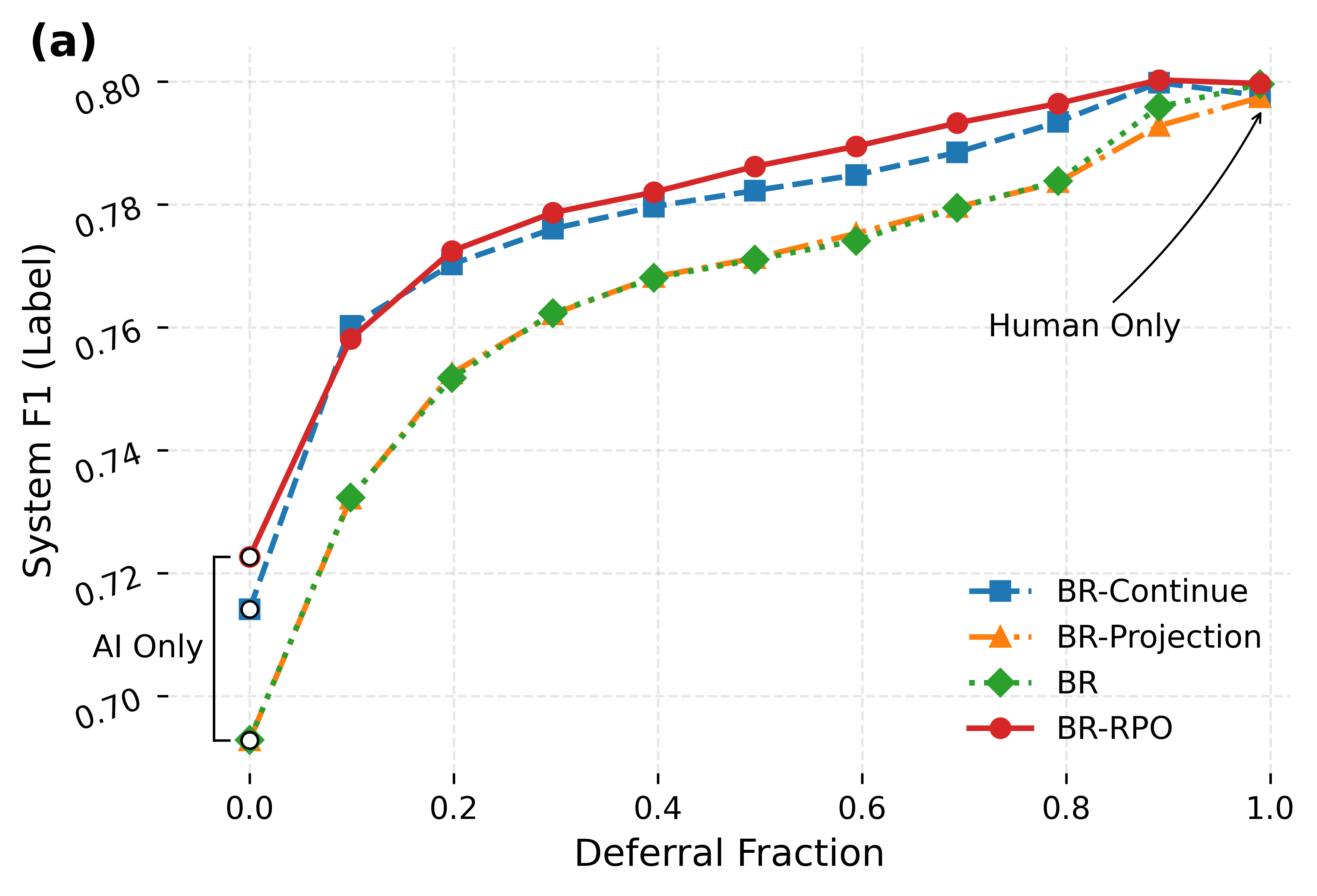
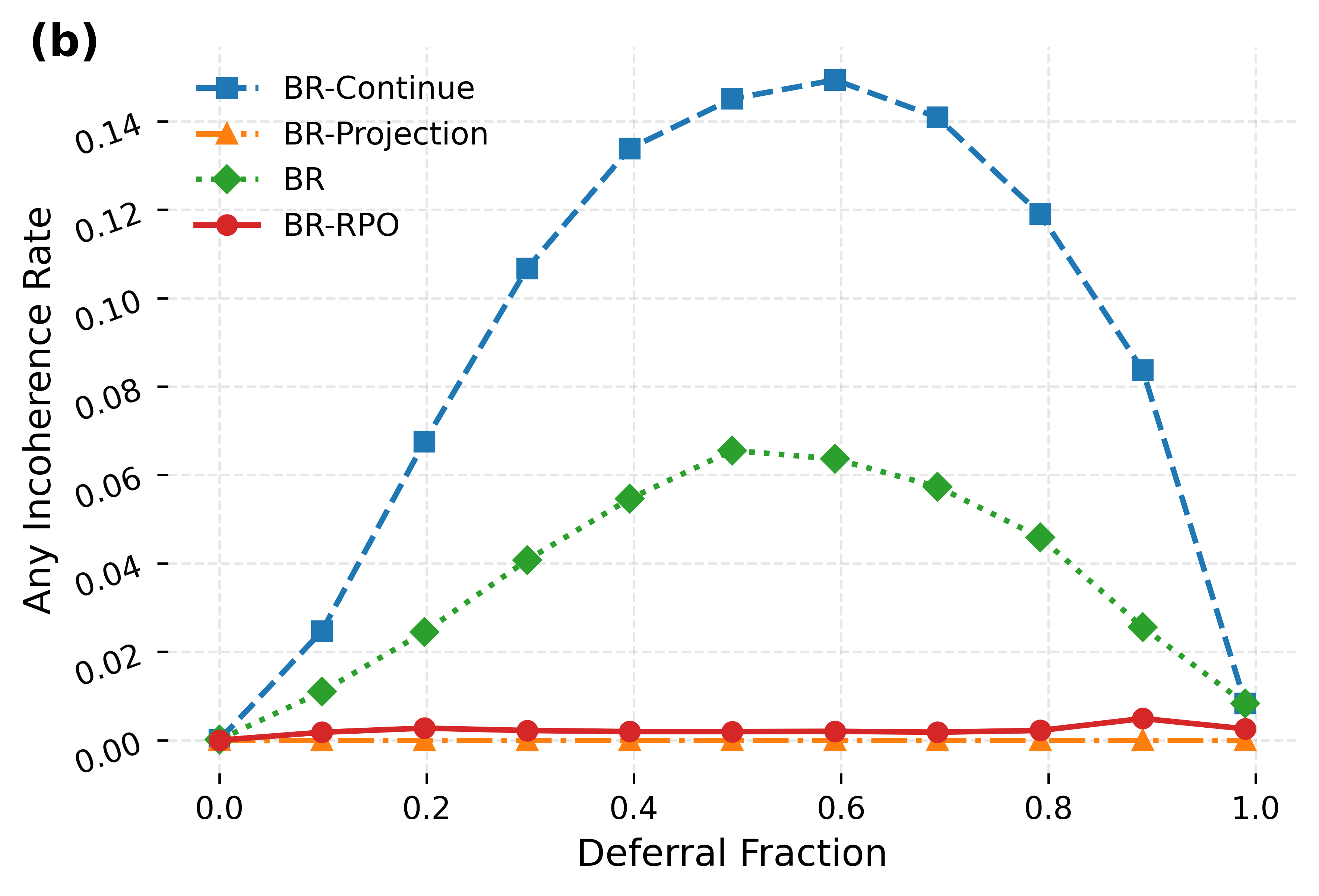
Across VinDr-CXR, CheXpert, PadChest, and ADPv2, exact projection removes incoherence by construction. TBP + RPO is almost coherent under fast decoding and often provides the strongest utility. That distinction is useful in practice: projection is a dependable guardrail, while joint training can learn a better division of work.
What I take from the paper
The main lesson is not limited to chest X-rays. A deferral system is defining a boundary of responsibility. Whenever decisions have structure—taxonomies, prerequisites, temporal dependencies, or shared constraints—that boundary should be represented explicitly.
Maximising the number of correct AI predictions is only part of the objective. A clinically useful handover must also be understandable: the reader should know what the model has decided, what remains open, and why their input is still needed. Coherence is one concrete step toward that more human-centred notion of utility.